Generative AI Integration | A Step-by-Step Guide for Businesses 2026

Featured Posts
Key Takeaways
- Generative AI integration succeeds or fails based on workflow design and data readiness, not on which model you pick.
- Most organizations now use generative AI somewhere in the business, but a much smaller share have scaled it past the pilot stage.
- A phased framework audit, use case, tools, architecture, pilot, governance, training, scale reduces both cost overruns and compliance risk.
- Governance and security guardrails work best when built in from step one, not bolted on after a rollout.
- The same generative AI reshaping your internal operations is also reshaping how prospects discover vendors, through AI Overviews, ChatGPT, Gemini, and Claude rather than traditional search results alone.
Generative AI integration is the process of embedding generative AI models, such as large language models and image or code generators, into a company’s existing tools, workflows, and data systems so employees and customers can use them safely and productively. Done well, it follows a structured path, audit readiness, pick the right use cases and tools, build a pilot, connect it to existing systems, add governance, train staff, then monitor and scale.
At Optimal IT Solutions, we’ve walked businesses of every size through this exact journey, from first AI readiness assessment to full enterprise rollout. This guide breaks the entire process into eight practical steps, shows you where most projects stall, and explains a factor most integration guides skip entirely: how generative AI is also changing the way your own customers find you online.
What Is Generative AI Integration?
Generative AI integration means connecting a generative AI model, such as a large language model (LLM), to the systems your business already runs on: your CRM, ERP, helpdesk, internal knowledge base, website, or proprietary applications. Instead of employees switching to a separate AI chat window, the AI becomes part of the workflow itself drafting a support reply inside the helpdesk, summarizing a contract inside the document management system, or generating a product description directly inside the e-commerce platform.
This is different from simply giving staff access to a public AI chatbot. Integration typically involves APIs, secure data pipelines, access controls, and testing to make sure the AI’s output is accurate, on-brand, and compliant with your industry’s regulations.
Why Generative AI Integration Matters for Businesses Right Now
Generative AI adoption has moved from experimentation to mainstream business practice. According to McKinsey’s State of AI research, the large majority of organizations now use AI in at least one business function, and a strong majority report regularly using generative AI specifically across marketing, product development, customer service, and IT.
McKinsey has also estimated that generative AI could add several trillion dollars in annual value across dozens of identified business use cases.
That opportunity comes with a catch. The same research consistently finds that most companies remain stuck running small pilots that never scale, while a much smaller group of “high performers” capture the majority of the financial benefit. The gap usually isn’t the AI model itself it’s the absence of a clear integration plan covering data readiness, workflow redesign, governance, and change management.
💡 Pro Tip: Don’t benchmark your progress against “how many AI tools we’ve tried.” Benchmark it against “how many AI use cases have moved from pilot to production with a measurable result.” That’s the metric that separates high performers from everyone else stuck experimenting.
Partner with AI Integration Experts
Successful AI adoption requires more than just technology—it requires the right strategy, expertise, and execution. At Optimal IT Solutions, we help businesses identify high-impact AI opportunities, implement scalable solutions, and maximize ROI. Start your AI transformation journey with a trusted technology partner.
How Generative AI Is Changing the Way Customers Find Businesses
Most generative AI integration guides stop at internal operations. But the same shift is changing how your prospects research vendors before they ever fill out a contact form. A growing share of B2B research now happens inside Google’s AI Overviews, ChatGPT, Gemini, and Claude not just in a list of blue links.
If your business is investing in generative AI internally but your content isn’t structured for these AI-driven discovery surfaces, you risk becoming invisible at the exact moment a prospect is comparing vendors.
This is where Answer Engine Optimization (AEO) and Generative Engine Optimization (GEO) come in. AEO focuses on structuring content so it can be lifted directly into AI-generated answers and featured snippets. GEO goes a step further, optimizing for how large language models select and cite sources when synthesizing a response, rather than just ranking a page in a results list.
Google’s own guidance on helpful, people-first content makes clear that genuine expertise and clear structure still underpin visibility, whether the surface is a traditional search result or an AI-generated summary.
Factor | Traditional SEO | AEO / GEO |
Primary goal | Rank a page in the results list | Get cited or summarized inside an AI-generated answer |
Content format | Long-form pages, keyword-targeted | Answer-first paragraphs, FAQs, tables, clear structure |
Key signal | Backlinks, keyword relevance | Factual density, clear sourcing, structured data, freshness |
Where it’s measured | Search Console rankings, click-through rate | Impressions with no clicks, brand mentions inside AI tools |
Time to see results | Weeks to months | Days for new content to enter AI citation pools, ongoing freshness required |
.
💡 Pro Tip: Treat your generative AI integration roadmap and your AI search visibility strategy as one project, not two. The same content discipline that makes your internal AI tools effective clean data, clear structure, factual accuracy is exactly what makes your public content easy for AI engines to find and cite.
How to Integrate Generative AI Into Your Business: An 8-Step Framework
Step 1: Audit Your Current Workflows and Data Readiness
Before choosing any tool, map the workflows you want to improve and assess whether your data is clean, accessible, and properly permissioned. Generative AI is only as useful as the data it can see.
A quick audit should answer three questions: Where does the relevant data live? Who currently owns each step of the workflow? And what would “success” look like in numbers hours saved, tickets resolved, or revenue generated?
Step 2: Identify and Prioritize High-Value Use Cases
Use Case | Business Impact | Implementation Difficulty | Typical Starting Tools |
Customer support draft replies | High | Low | Helpdesk-native AI assist, LLM API |
Internal document summarization | Medium | Low | LLM API + internal knowledge base connector |
Marketing copy first drafts | Medium | Low | LLM API or content tools |
AI-assisted software development | High | Medium | Coding assistant integrated with your repo |
Customer-facing chatbot | High | Medium–High | LLM API + retrieval-augmented generation (RAG) |
Automated contract or compliance review | High | High | Custom RAG + human-in-the-loop review |
Start with a use case in the “high impact, low difficulty” zone it builds internal trust and budget before you tackle the harder, higher-risk ones.
Step 3: Choose the Right Generative AI Models and Tools
Different tasks call for different models. Conversational and reasoning tasks often use large language models such as those behind ChatGPT, Claude, or Gemini; code-focused tasks may use a specialized coding assistant; image or design tasks need a separate generative model entirely.
Evaluate vendors on accuracy for your specific domain, data privacy commitments, pricing model, and how easily they integrate with your existing tech stack through APIs.
Step 4: Design Your Integration Architecture
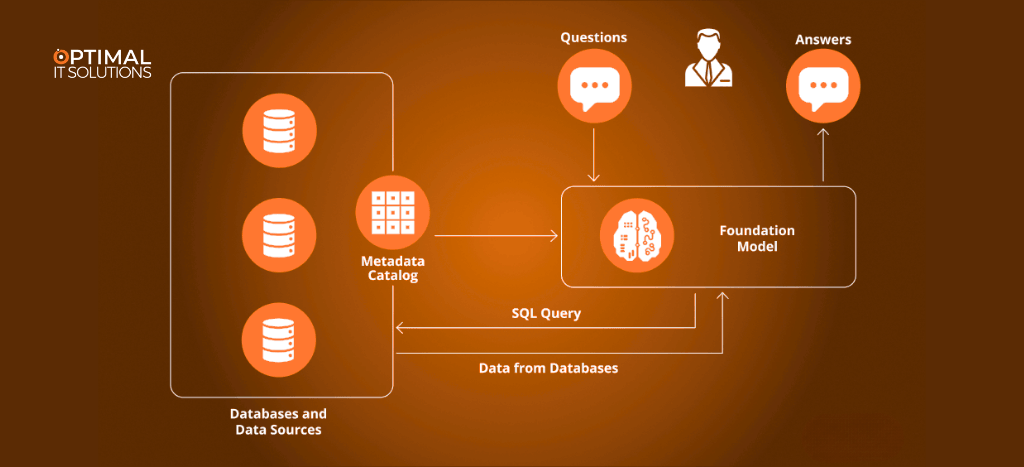
This is where generative AI integration becomes technical. You’ll typically need an API layer connecting the AI model to your existing software, a retrieval system (often called RAG, or retrieval-augmented generation) so the AI can reference your company’s actual documents and data, and clear rules for what data the AI is and isn’t allowed to access.
Businesses without in-house AI engineering talent often bring in an integration partner at this stage to avoid costly architecture mistakes.
Step 5: Build and Test a Pilot
Launch with a single team or department before a company-wide rollout. A typical pilot runs four to eight weeks and should include real users, real (not sample) data, and a clear set of success metrics defined back in Step 1.
💡 Pro Tip: Document every failure mode during the pilot hallucinated answers, slow response times, awkward handoffs to a human. These are far cheaper to fix in a four-week pilot than after a company-wide launch.
Step 6: Establish Governance, Security, and Compliance Guardrails
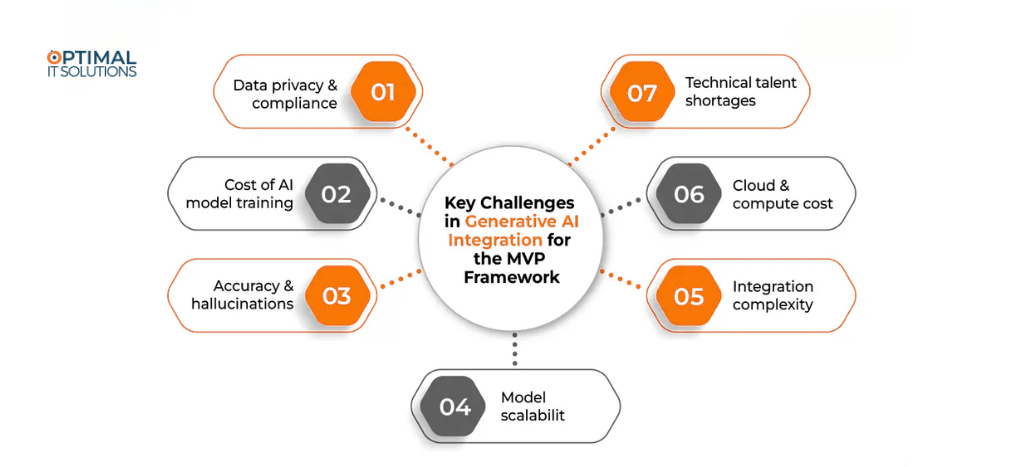
Generative AI introduces new risks: data leakage, inaccurate or “hallucinated” outputs, and regulatory exposure, especially in healthcare, finance, and legal services. Build guardrails before scaling, not after: access controls, output review processes for high-stakes content, audit logs, and alignment with frameworks such as the NIST AI Risk Management Framework.
If you operate in or sell into the EU, also review obligations under the EU AI Act.
Step 7: Train Your Team and Manage Change
The biggest threat to a generative AI rollout often isn’t the technology it’s adoption. Train employees not just on how to use the new tools, but on when to trust AI output and when to escalate to a human. Identify internal champions on each team who can answer day-to-day questions, and set expectations early that the AI is meant to assist work, not replace judgment.
Step 8: Monitor, Measure, and Scale
Once your pilot proves value, expand deployment in phases rather than all at once. Track the same metrics you defined in Step 1, alongside newer signals like user adoption rate and error/escalation rate. Revisit your governance rules every quarter, since both the underlying models and the regulatory landscape continue to evolve quickly.
Common Challenges in Generative AI Integration
Challenge | Why It Happens | How to Avoid It |
Messy or siloed data | Information is spread across disconnected systems with inconsistent formatting | Run the Step 1 data audit before selecting tools, not after |
Legacy systems without modern APIs | Older software wasn’t built for AI-era integrations | Plan for middleware or a phased modernization budget upfront |
Hallucinated or inaccurate outputs | LLMs generate plausible-sounding but unverified text | Add a human-review checkpoint for any high-stakes workflow |
Employee resistance | Staff fear job displacement rather than role enhancement | Communicate transparently and involve teams early in use-case selection |
Cost overruns | Companies budget for the AI subscription but not the engineering integration time | Scope the full architecture (Step 4) before committing to a timeline or budget |
How Long Does Generative AI Integration Take?
Project Scope | Typical Timeline |
Single-use-case pilot | 4–8 weeks |
Single-department production rollout | 2–4 months |
Company-wide, multi-department integration | 6–12 months (longer in regulated industries) |
Working with an experienced integration partner can meaningfully shorten each of these timelines by avoiding common architecture and governance mistakes.
Build In-House vs. Partner With an Integration Firm
Speed to first pilot | Slower requires hiring or upskilling AI engineers | Faster existing architecture patterns and tooling |
Upfront cost | Lower software cost, higher hidden labor cost | Predictable project-based or retainer cost |
Governance expertise | Built from scratch, higher risk of gaps | Established frameworks already aligned to NIST/EU AI Act |
Ongoing support | Depends entirely on internal team retention | Continuity built into the engagement |
Best fit for | Large enterprises with a dedicated AI engineering team already in place | Mid-sized businesses without in-house AI engineering, or anyone wanting to move faster |
How Optimal IT Solutions Helps Businesses Integrate Generative AI
Optimal IT Solutions works with businesses at every stage of this framework, from an initial AI readiness assessment through full-scale, secure deployment. Our team handles the technical heavy lifting API integrations, RAG architecture, and security guardrails so your internal teams can focus on adoption and results rather than infrastructure.
Transform Your Business with Generative AI
Ready to unlock the power of generative AI? From automating workflows and enhancing customer experiences to improving productivity and decision-making, the right AI strategy can deliver measurable business results. Let Optimal IT Solutions help you seamlessly integrate AI into your operations with a customized implementation plan tailored to your goals.
Conclusion: Generative AI Integration Is a Process, Not a Product Purchase
The businesses seeing real returns from generative AI in 2026 aren’t the ones that bought the most AI subscriptions, they’re the ones that treated integration as a structured, multi-step initiative with clear ownership, data readiness, and governance built in from day one. The eight-step framework above gives you that structure, whether you’re running your first pilot or trying to get a stalled project back on track.
It’s also worth remembering that generative AI integration doesn’t stop at your internal workflows. As more of your prospects research vendors through AI Overviews, ChatGPT, Gemini, and Claude rather than a traditional results page, the same discipline you apply internally, clean data, clear structure, factual accuracy, determines whether your business shows up in those conversations at all.
Optimal IT Solutions builds both sides of this into every engagement: the internal integration work and the AI-visibility strategy that goes with it, so the investment pays off in productivity and in pipeline.
Let me know when you’re ready to have this (and anything else you’re collecting) folded into the actual files.
FAQ's
It’s the process of connecting AI tools that generate text, images, or code directly into the software your business already uses, rather than running them as a separate, disconnected chat tool.
Costs vary widely based on the number of use cases, data complexity, and whether you need custom development versus off-the-shelf AI tools. A focused single-use-case pilot is far less expensive than a multi-department rollout; most businesses start with one pilot to validate ROI before committing to a larger budget.
Most businesses don’t need to build a custom model. Integrating an existing model through its API, combined with your own data via retrieval-augmented generation, is faster, cheaper, and sufficient for the vast majority of business use cases.
Inaccurate or “hallucinated” outputs reaching customers or decision-makers without a human review step. Building review checkpoints into high-stakes workflows from the start is the most effective way to manage this risk.
Often yes, through API connections or middleware, though older systems without modern APIs may require additional integration work or a phased modernization approach.
Yes, indirectly but meaningfully. As more buyer research shifts into AI Overviews, ChatGPT, Gemini, and Claude, businesses need their public content structured for AEO/GEO clear answers, structured data, and factual accuracy alongside their internal AI integration work, or they risk losing visibility even as they adopt AI internally.
Track the specific metrics tied to your original use case hours saved, tickets resolved, response time, conversion rate rather than generic AI usage statistics. ROI should be measured against the workflow you set out to improve in Step 1.
Let's Connect With Our Experts
Get valuable consultation form our professionals to discuss your projects. We are here to help you with all of your queries.
Revolutionize Your Business
Collaborate with us and become a trendsetter through our innovative approach.